Table of Contents Show
Stock image.
The word on the Chinese street is that metals are the next hot thing. All you need to join the bull party is an online trading account, a bit of cash for the initial margin and access to the right WeChat chatroom to meet like-minded punters.
China’s metal exchanges have for two months been struggling to contain the unprecedented liquidity rush caused by the spreading metals mania.
The Shanghai Futures Exchange and the Guangzhou Futures Exchange have between them raised margins and tightened trading rules 38 times to maintain order.
The spate of interventions has covered the metallic spectrum from precious metals gold and silver to industrial inputs such as nickel and lithium.
China has a long history of manias in markets as obscure as ferro-silicon but nothing before on this scale.
Moreover, metals fever has swept up the rest of the world. The speculative stampede has generated extreme volatility in the silver market and rocked even safe-haven gold.
ShFE volumes of aluminum, copper, nickel and tin
Mass momentum
The Shanghai Futures Exchange registered record levels of trading activity across multiple metal contracts in January.
Tin volumes exceeded one million metric tons on a single day as the price accelerated to fresh all-time highs. That’s more than twice the world’s annual physical usage.
The crowding of retail investors acts as a giant momentum fund, every price gain feeding the next leg higher as more money joins the uptrend. Short positions held by industrial hedgers are stopped out, throwing further fuel on the flames.
Outside of China, only silver has seen similar mass surges in the past, most notably in 2021, when the Reddit message board launched a wave of retail buying in pursuit of a mythical market short.
No surprise then that silver has once again been the wildest of all markets in recent days.
But this phenomenon is spreading.
The late-January surge in the CME copper contract to a record high of $6.58 per lb wasn’t accompanied by any outsize increase in managed money long positions.
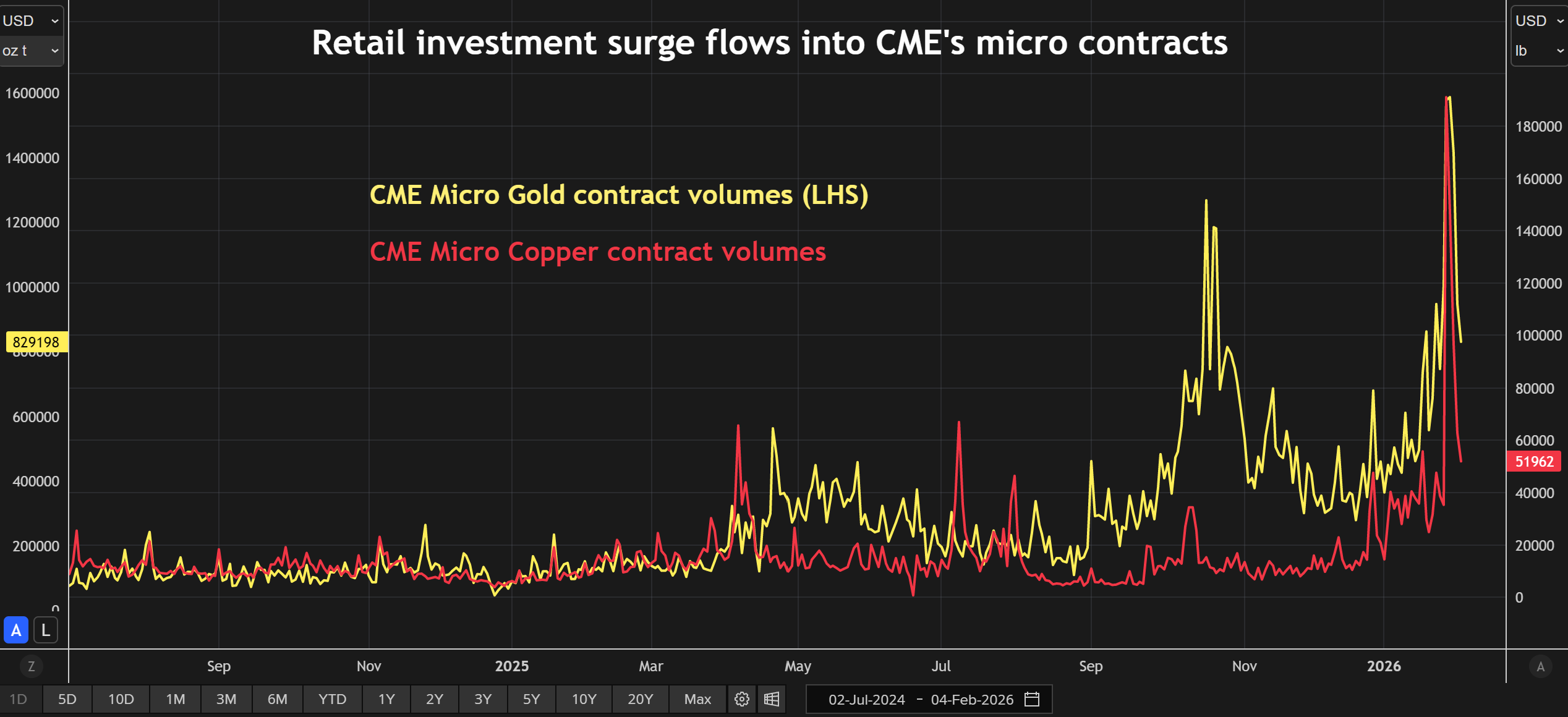 CME micro copper and micro gold volumes
Rather, the real action was taking place in the CME’s smaller contracts aimed squarely at retail investors.
The micro copper contract, which at 2,500 pounds is a tenth of the size of the main contract, saw volumes mushroom from 369,000 lots in December to 969,000 in January. That’s equivalent to over one million metric tons of physical metal.
The micro gold contract has experienced an equally dramatic jump in activity after bursting into life around the middle of last year.
Delta force
The wave of investment money has been flowing into metal options as well as futures.
The CME’s copper event option contract, which offers a simple binary punt on the underlying price, notched up volumes of almost 83,000 lots in December and January, more than the total traded since the product was launched in September 2022.
Options act as accelerators on already super-charged rallies.
With everyone looking to snap up call options, conferring the right to buy, sellers have to hedge their exposure by themselves buying into a rising market.
Such delta-hedging creates a mechanistic feedback loop, which runs until the momentum turns, at which point the process starts working in reverse as those who sold the options sell back their cover in a falling market.
The whiplash can be extreme, as silver investors have just found out.
Liquidity trap
Animal spirits, compounded by options leverage, created the conditions for both the wild upswing in precious metals prices and the subsequent violent unwind.
Gold should be cushioned against such speculative storms by central bank reserves but it too is ultimately a finite physical commodity.
Analysts at Citi calculate that were investors to increase their purchases of gold from the current $300-400 billion per year to $2 trillion, the price could exceed $10,000 per ounce.
That may sound like a lot of money but an increase from $1 trillion to $2 trillion would represent just one six-hundredth of global household wealth, according to Citi.
If even gold is vulnerable to the raw power of money, consider the potentially destructive impact on smaller industrial metal markets such as nickel or tin.
That’s why China, the world’s foremost industrial metals producer and consumer, has been taking ever more stringent measures to prevent paper market wildness contaminating real-world supply chains.
Theme and meme collision
January’s perfect metallic storm marks the collision of two powerful investment themes.
The fear of dollar “debasement” is causing both institutional and individual investors to diversify into harder assets.
Metals, meanwhile, were already attracting investor interest due to their central role in both energy transition and internet-of-things mega-trends.
Silver, which is both a precious and industrial metal, has been the pivot between macro- and micro-investment narratives.
In the new world of social media, these colliding metallic themes have morphed into internet memes, amplified by message boards such as WeChat in China and Reddit in the West.
The result is unprecedented investment appetite for metals, both precious and base, at global scale.
And it’s unlikely to be sated any time soon.
More turbulence seems guaranteed until the fever breaks.
If it breaks.
(The opinions expressed here are those of the author, Andy Home, a columnist for Reuters.)
(Editing by David Holmes)